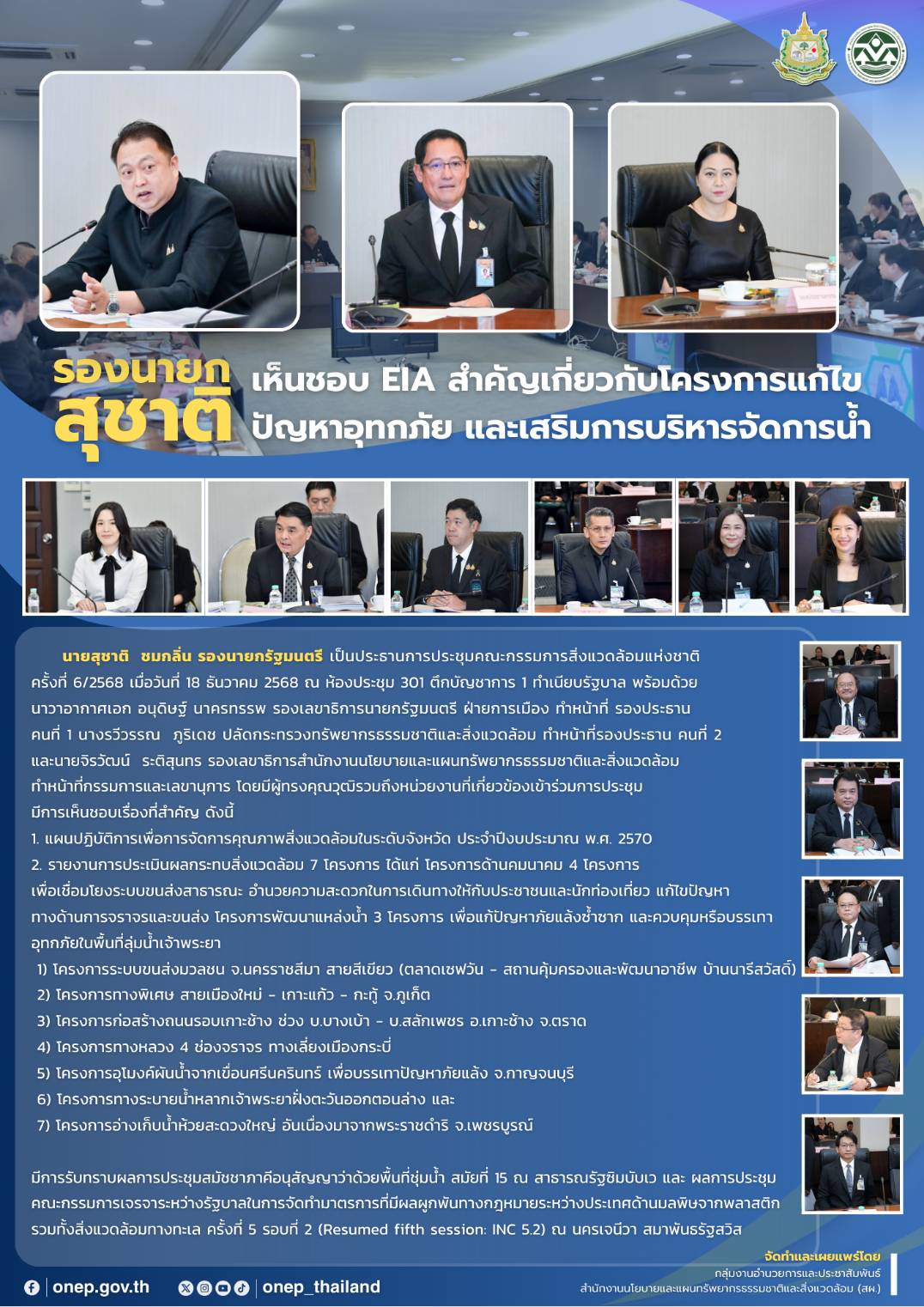
Associate Professor Suthin Wianwiwat, Dean of the Faculty of Economics, Khon Kaen University (KKU), attended the 6th/2025 meeting of the National Environment Board (NEB) on 18 December 2025.
The meeting was chaired by Mr. Suchart Chomklin, Deputy Prime Minister, and included expert committee members and representatives from relevant agencies. The assembly took place in Meeting Room 301, Command Building 1, at Government House.
The NEB convened this meeting to deliberate on key environmental issues and national sustainable development priorities. The objectives included strengthening policy and planning integration, enhancing inter-agency cooperation, and promoting systematic knowledge exchange among relevant organisations. Such collaboration is essential for effective long-term management of natural resources and environmental conservation.
Associate Professor Suthin Wianwiwat, Dean of the Faculty of Economics, Khon Kaen University, remarked that he felt deeply honoured to be appointed as an expert member in Environmental Economics on the National Environment Board, representing the Faculty of Economics and Khon Kaen University.
“Serving on a committee that plays a crucial role in shaping the nation’s environmental policy direction provides a valuable opportunity to apply environmental economics for the benefit of society and the country,” said Associate Professor Suthin. “This meeting addressed several critical issues with direct implications for sustainable development and the long-term quality of life of the population.”
The Dean further explained that the NEB meeting covered a wide range of agenda items, integrating perspectives from international environmental policy, natural resource governance, and environmentally sustainable infrastructure development. Discussions included reports on international conference outcomes, the formulation of provincial-level action plans, and the review of Environmental Impact Assessment (EIA) reports for major development projects.
Associate Professor Suthin stressed the necessity for economic development and environmental protection to proceed hand-in-hand. “Utilising the principles of environmental economics in the analysis and appraisal of various projects is essential. It helps ensure a sustainable balance between development initiatives and the conservation of nature,” he concluded.