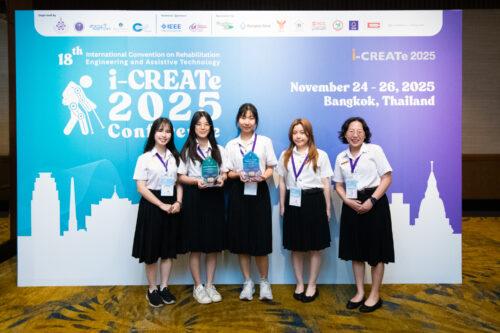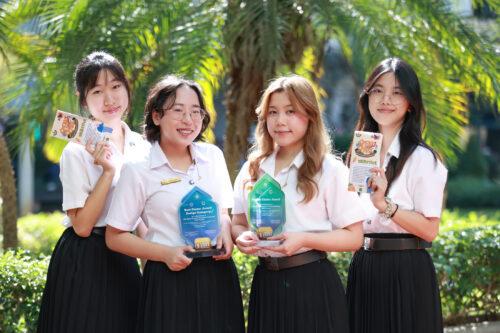

Khon Kaen University (KKU) Faculty of Medicine proudly announces the success of its medical students and Dual Degree (MDH) medical students, who won prestigious awards at an international competition for their innovative game application designed for patients experiencing speech and swallowing difficulties.
The innovation, titled ‘SPEAK SPARK!’, was presented at the 18th International Convention on Rehabilitation Engineering and Assistive Technology (i-CREATE 2025), hosted under the theme “Empowering Life: Human-Centred Innovation in Health, Wellness, Aging, and Abilities.” The event was organised by the National Science and Technology Development Agency (NSTDA) and the Information Technology Foundation under the Initiation of Her Royal Highness Princess Maha Chakri Sirindhorn, in collaboration with the Faculty of Engineering, Mahidol University.
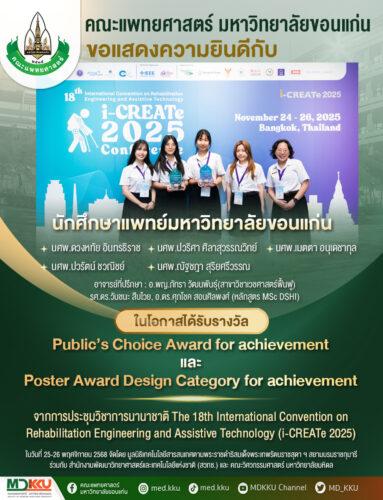
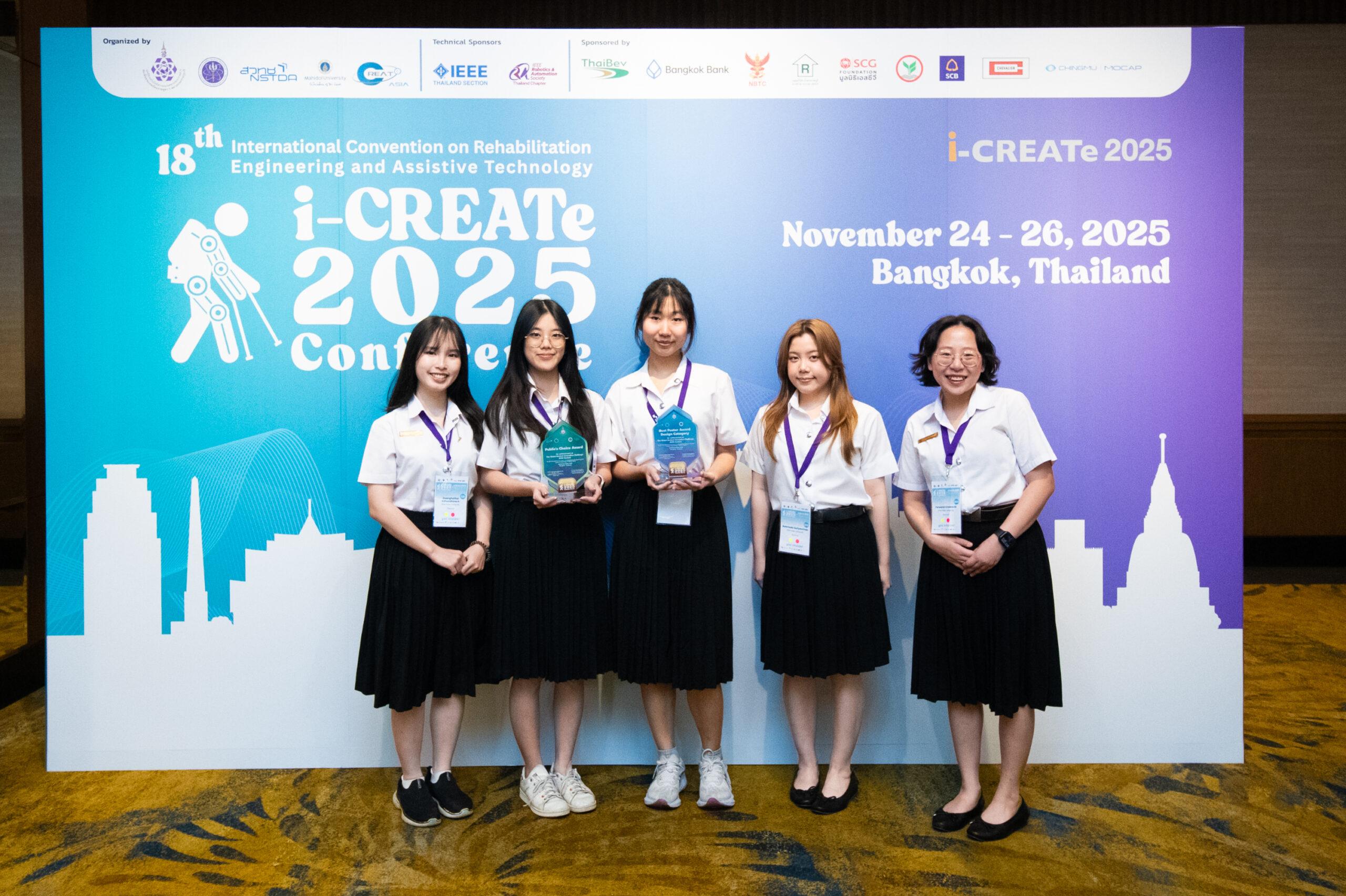
The student team comprised: Duanhathai Intrathirat (MDH Medical Student), Pavarat Chawanich (MDH Medical Student), Metta Anudechakul (MDH Medical Student), Pavarisa Silasuwanwit (MDH Medical Student), and Natchada Suriyasriwan (Medical Student).
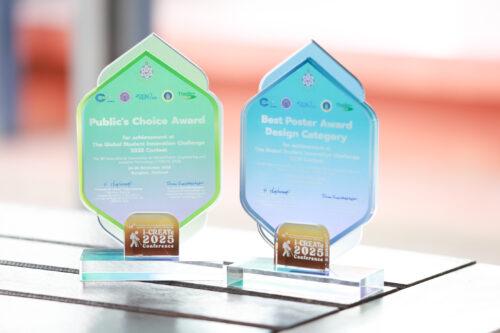
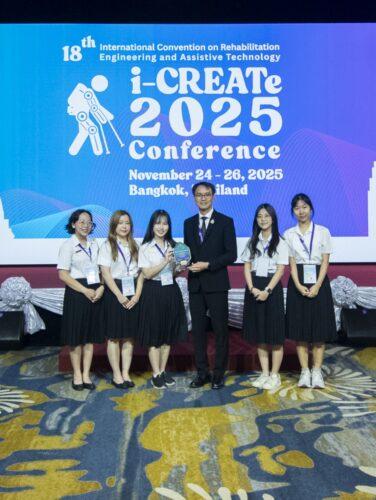
The team excelled in the national selection, being chosen as one of the 10 representative teams from Thailand to advance to the Global Student Innovation Challenge (GSIC), a competition exclusively for high school and university students. They navigated two challenging rounds: the Oral Presentation or Pitching round (a 5-minute presentation) and the Prototype Demonstration round, which required a booth display and real-time testing by the judging panel. Their exceptional work earned them the Public’s Choice Award for achievement and the Best Poster Award Design Category for achievement.
The students were inspired to develop the application after observing a practical issue faced by patients. Patients with speech or swallowing difficulties typically receive paper handouts for at-home practice, with no mechanism to confirm the correctness of their training. Interviews with occupational therapists revealed that visual and auditory feedback indicating accuracy could significantly motivate and encourage patients.
The student team incorporated concepts from a popular voice-controlled game on TikTok, merging it with medical therapeutic regimes. This resulted in a gamified application featuring engaging graphics, interactive assessments, and enjoyable physical rehabilitation exercises. Furthermore, the application collects data for the medical team to evaluate treatment efficacy.
The SPEAK SPARK! application features three specialised games:
- Quack Quack: Focuses on sustaining vocal duration and controlling volume (decibels) for patients experiencing fragmented speech.
- Pitch Fly: Focuses on adjusting high and low voice frequencies (pitch) for patients with Monotone Voice (speech that sounds flat or robotic).
- Shop Shop: Focuses on articulating specific sounds clearly, particularly for patients who struggle to pronounce complete words (e.g., saying “khon-nun” instead of “kha-nom” or ‘dessert’). This game starts at a basic level and gradually increases in difficulty, helping patients achieve more natural speech patterns.
Pavarat Chawanich, Medical Student, explained that the primary target audience includes patients with brain, head, or neck injuries, as well as those with Parkinson’s disease and stroke who suffer from dysphagia (swallowing difficulties) and dysarthria (speech difficulties).
“In the future, we plan to expand the application’s utility to children who are in the process of speech development,” Ms. Duanhathai stated. “What truly sets this application apart is the Personal Calibration feature. It measures each individual’s standard vocal range as a baseline for setting the game difficulty. This ensures the level of difficulty genuinely matches the patient’s speaking ability.”
She added that the application provides Visual Feedback using the camera to monitor the patient’s mouth shape during speech. Future developments include integrating AI-driven cartoon characters that demonstrate correct articulation as a model for the patients.
Natchada Suriyasriwan, Medical Student, saying: “If you have an idea or an interest in research or innovation, start now. The Faculty of Medicine is extremely supportive. Simply contact the relevant professors, and you will receive excellent assistance. Although medical studies are rigorous, dedicating time to external activities or personal interests offers a valuable opportunity. It helps build networks, provides experience, and imparts new knowledge. Stepping outside your comfort zone and daring to try new things will lead to future growth and opportunities. This is an invaluable experience for learning and self-development.”
The Faculty of Medicine provided comprehensive support for this project, covering development costs, equipment, and full sponsorship for all competition rounds. Crucially, the team received guidance from three dedicated advisors:
- Adjunct Professor Patra Watanaphan, M.D., from the Division of Rehabilitation Medicine, provided clinical medical advice, helping the team identify the research problem and highlighting the critical impact of dysphagia on patients’ eating habits and mental health—an area of her specific expertise.
- Dr. Suppachok Sonsilphong, from the Medical Data Science Programme, assisted with technical development and programming aspects.
- Associate Professor Wanachana Suebwai, Ph.D., provided invaluable assistance with research regulations and documentation procedures.
The application is currently at the prototype stage, and the team has initiated the patent registration process. Having received certification from the Human Research Ethics Committee, the team is now moving forward with testing the prototype on actual patients—a crucial step toward refining the programme for practical service delivery in the near future.